Buying Agricultural Land in Ecuador: Secure Your Finca with Essential Legal Checks
Navigate buying a finca in Ecuador with confidence. Understand water rights, zoning (GADs, COOTAD), and crucial legal steps like Cuerpo Cierto vs. Derechos y Ac
Buying Agricultural Land ("Finca") in Ecuador: Water Rights, Zoning, and Crucial Legal Considerations
Investing in agricultural land, or a finca, in Ecuador is a compelling vision for many. Whether you dream of a self-sustaining homestead, a boutique coffee farm, or a large-scale agricultural venture, the potential of the Ecuadorian countryside is immense. However, as a legal professional with extensive experience guiding expatriates through property acquisitions, I have seen firsthand how this dream can become a bureaucratic nightmare without meticulous, locally-informed legal counsel.
This guide moves beyond generic advice to demystify the process of acquiring a finca. We will focus on the most critical and often misunderstood legal hurdles: water rights, land use regulations, and the essential due diligence that protects your investment. My goal is to equip you with the specific knowledge needed to proceed with confidence, ensuring your purchase is secure and fully compliant with Ecuadorian law.
Understanding the Fundamentals: Types of Rural Property Titles
Before any discussion of land, you must understand what you are actually buying. In Ecuador, rural land ownership is not always straightforward. You will primarily encounter two forms:
- Cuerpo Cierto (Defined Property Body): This is the ideal and most secure form of ownership. The property has a specific, surveyed boundary, a unique cadastral number (clave catastral), and a clear, individual title registered in the Land Registry (Registro de la Propiedad). This is the only type of property you should consider purchasing without significant legal risk mitigation.
- Derechos y Acciones (Rights and Actions): This represents a percentage share of a larger, undivided property. You do not own a specific, demarcated piece of land, but rather a conceptual share of the whole. This is a common source of legal disputes among co-owners and presents significant risks for development, financing, and resale. Avoid derechos y acciones properties unless you are prepared for a complex and costly legalization process.
Water Rights: The Non-Negotiable Lifeblood of Your Finca
In Ecuador, water is not a private commodity; it is a strategic public good owned by the state. This is a fundamental legal principle that surprises many foreign buyers. Just because a river flows through your property does not grant you the legal right to use its water for irrigation.
Key Legislation: The Water Law and State Authority
The Ley Orgánica de Recursos Hídricos, Usos y Aprovechamiento del Agua (Organic Law of Water Resources, Uses and Exploitation of Water) is the governing statute. Article 2 of this law establishes that water is a national public good, inalienable and essential for life. The regulating body is the Autoridad Única del Agua (formerly SENAGUA), which authorizes and controls its use.
Verifying and Securing Water Use Rights
Any use of water beyond minimal domestic needs (personal consumption, a small family garden) requires a formal authorization, known as an Autorización de Uso y Aprovechamiento del Agua.
- Existing Concessions: If the seller claims to have water rights, do not rely on verbal assurances or the mere presence of irrigation infrastructure. Your lawyer must obtain a certificate from the Autoridad Única del Agua confirming a valid, registered authorization linked to the specific property (predio). This authorization details the source (river, spring, well), the permitted flow rate (caudal), and the purpose (e.g., irrigation for 5 hectares of pasture).
- Community Water (Juntas de Agua): This is a critical, hyper-specific detail many overlook. Much of rural Ecuador is irrigated via community-managed canals (acequias). Rights to this water are governed by a local Water Board (Junta de Administradora de Agua Potable y Saneamiento or Junta de Riego).
- Common Pitfall: A seller might say, "The property has irrigation water," pointing to a nearby acequia. This right is not automatically transferred with the land deed. You must verify that the seller is a registered member of the Junta, is current on their fee payments (alícuotas), and that the Junta's bylaws permit the transfer of this right to a new owner. Failure to do this could leave you with land but no legal access to the water flowing right past it.
Zoning and Land Use Regulations: What You Can Actually Do
While rural areas are less rigidly zoned than urban centers, municipal governments (Gobiernos Autónomos Descentralizados - GADs) hold significant power over land use, granted by the Código Orgánico de Organización Territorial, Autonomía y Descentralización (COOTAD).
Verifying Permitted Land Use
Before purchasing, you must verify what is legally permissible on your target property.
- Certificado de Afectación y Licencia Urbanística (IRL): This is the single most important document from the municipal Planning Department (Dirección de Planificación). Often referred to simply as the Uso de Suelo, this certificate officially states the property's classification (e.g., Agrícola Residencial, Protección Ecológica) and lists permitted and prohibited activities. It will also show any public works projects that might affect the property, such as future road widening.
- Protected Areas and Setbacks: The certificate will also note if the land falls within a protected forest (bosque protector), an area of ecological importance, or near a river, which imposes strict construction setbacks (retiros). Building too close to a river can result in fines and demolition orders.
- Ministry of Agriculture (MAG): For very large properties, or if you plan to subdivide agricultural land, a favorable report (informe favorable) from the Ministry of Agriculture and Livestock may be required. This is to ensure that the division does not create plots smaller than the designated Minimum Agricultural Unit (Unidad de Producción Agrícola - UPA), which varies by region.
The Due Diligence Checklist: A Lawyer's Mandate
Beyond water and zoning, a rigorous legal review is non-negotiable.
1. Title Search (Estudio de Títulos)
This is a comprehensive investigation at the local Registro de la Propiedad. Your attorney will request a Certificado de Gravámenes, which costs approximately $15-$25 and provides a complete history of the property for the last 30+ years. This certificate reveals:
- Clear Ownership (Dominio): Confirms the seller is the legal owner.
- Encumbrances (Gravámenes): Shows any mortgages, liens, seizure orders, or other debts attached to the property.
- Easements (Servidumbres): Discloses legal rights of way for paths, roads, or water pipes that may cross the property.
- Prohibitions to Sell (Prohibiciones de Enajenar): Reveals if a court order prevents the seller from legally transferring the property.
2. Cadastral Verification (Verificación Catastral)
The municipal catastro department holds the property's tax and boundary information. It is crucial to ensure that the area, boundaries (linderos), and cadastral number on the title deed match the municipal records and the physical reality of the land. Discrepancies are common and must be resolved before purchase.
3. Topographical Survey (Levantamiento Topográfico)
For rural properties with vaguely defined boundaries ("from the old ceibo tree to the big rock"), a modern GPS-based survey by a licensed topographer is essential. This prevents future boundary disputes with neighbors, which are a frequent source of conflict in the Ecuadorian countryside.
4. The Purchase Agreements
- Promesa de Compraventa (Promissory Purchase Agreement): This is a binding preliminary contract. It locks in the price and terms and should include contingency clauses making the final sale dependent on a clean title search, confirmation of water rights, and favorable land-use certification. A penalty clause (cláusula penal) should be included for default by either party.
- Escritura Pública de Compraventa (Final Deed of Sale): This is the final document executed before a Notary Public (Notario Público). It legally transfers ownership and is the document that will be registered at the Registro de la Propiedad to complete the transaction.
5. Taxes and Fees
Budget for the following closing costs, which are primarily the buyer's responsibility:
- Transfer Tax (Impuesto de Alcabala): Varies by municipality but is typically around 1% of the sale price.
- Provincial Tax (Impuesto Consejo Provincial): A small tax levied by the provincial government.
- Notary and Registration Fees: Calculated based on the property value.
- Annual Property Tax (Impuesto Predial Rural): An ongoing annual tax paid to the municipality.
⚠️ Legal Red Flags: When to Immediately Halt a Transaction
Stop and seek immediate legal counsel if you encounter any of the following:
- The property is being sold as "Derechos y Acciones" instead of a "Cuerpo Cierto."
- The seller cannot produce a recent, clean Certificado de Gravámenes.
- The seller's water rights are based on verbal agreement or are not registered with the Autoridad Única del Agua or the local Junta de Agua.
- There are significant discrepancies between the deeded area and the municipal cadastral records.
- The seller pressures you to pay a large sum or sign a final deed without a preliminary Promesa that allows for due diligence.
- The seller is reluctant to allow a new topographical survey to confirm boundaries.
Acquiring a finca in Ecuador is a fantastic opportunity, but it demands a proactive and defensive legal strategy. By understanding these specific Ecuadorian legalities—from state ownership of water to the crucial difference between cuerpo cierto and derechos y acciones—you can navigate the process securely and build your dream on a solid foundation.
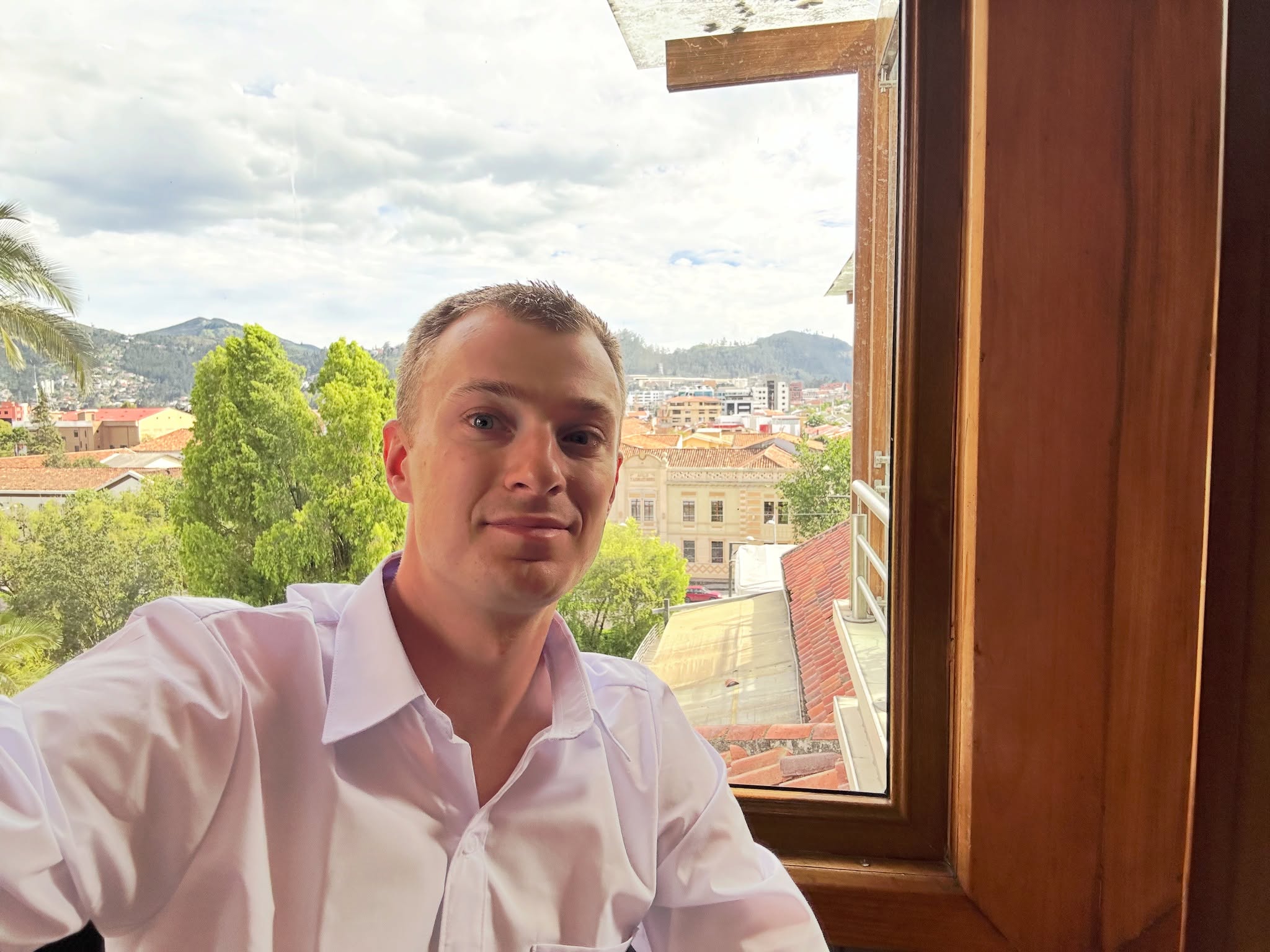
About the Author
Chip Moreno — American Expat in Cuenca, Ecuador
Chip is the founder of EcuaPass (Ecuador visa services), FileAbroad (U.S. taxes for expats), EcuaInsure (health insurance), EcuadorTranslations, and CuencaExpat (daily news). He holds a B.S. in Computer Science from WGU, obtained his Ecuador Professional Visa in 2025, and is pursuing the IRS Enrolled Agent credential and an Ecuadorian insurance broker license.