Is a Topographic Survey MANDATORY Before Buying Property in Ecuador? Expat Guide
Discover why a 'levantamiento topográfico' (topographic survey) is a non-negotiable step for expats buying property in Ecuador. Protect your investment from leg
Do You Need a Survey ('Levantamiento Topográfico') Before Buying Property in Ecuador? An Expat's Definitive Guide
As an expat contemplating a real estate investment in Ecuador, particularly in the charming and historically rich city of Cuenca, you’re embarking on an exciting journey. The allure of owning a piece of this beautiful country is undeniable, but navigating the local legal landscape can feel like traversing an intricate labyrinth. One question that frequently arises, and often with significant consequences, is the necessity of obtaining a topographic survey, or "levantamiento topográfico," before finalizing a property purchase.
As an Ecuadorian lawyer with extensive experience assisting expats in real estate transactions, I can state with absolute certainty: Yes, commissioning an independent levantamiento topográfico is non-negotiable before buying property in Ecuador. To proceed without one is to invite potential legal disputes, financial losses, and significant stress. This isn't merely a suggestion; it's a critical, non-negotiable step rooted in Ecuadorian property law and best practices designed to protect your investment.
Understanding the 'Levantamiento Topográfico' in the Ecuadorian Context
A levantamiento topográfico in Ecuador is far more than a simple sketch of boundaries. It is a detailed, official technical document prepared by a licensed Ecuadorian civil engineer (Ingeniero Civil) or surveyor, registered with the SENESCYT. This document precisely defines the physical boundaries of a property using georeferenced coordinates (typically WGS84), its exact area, its topography, and its relationship to surrounding properties and public infrastructure.
Crucially, it rectifies a common and perilous issue: descriptions in older deeds (escrituras) are notoriously vague, often referencing "una quebrada" (a ravine), "el cerco de pencos" (an agave fence), or a neighbor's name from decades ago. These landmarks may no longer exist or may have shifted, making such descriptions legally indefensible in a modern dispute. The survey replaces this ambiguity with mathematical certainty.
The levantamiento topográfico is the foundational document that underpins:
- Property Registration: The Municipal Cadastre (Catastro Municipal) and the Property Registry (Registro de la Propiedad) rely on accurate surveys to record and verify property details.
- Dispute Resolution: In cases of boundary disputes (conflictos de linderos), encroachment, or claims from neighbors, an official survey is the primary legal instrument for resolution.
- Construction and Development: Any future building plans require adherence to defined property limits. Furthermore, to obtain a building permit, you first need an Informe de Regulación Metropolitana y Urbana (IRMU) from the Cuenca municipality's Dirección de Control Urbano. This crucial report, which outlines zoning restrictions and building allowances, cannot be issued without a recent and approved levantamiento topográfico.
- Legal Certainty: It provides clear, irrefutable evidence of what you are legally buying, down to the last square meter.
Why Expats Are Particularly Vulnerable Without a Survey
Expats, while enthusiastic, often lack familiarity with these local legal nuances. This can make them targets for misrepresentation or, more commonly, unintentional errors that a survey would immediately expose. Common pitfalls include:
- Boundary Encroachments (Invasiones): A seller might unknowingly (or sometimes knowingly) be occupying a portion of a neighbor's land, or vice-versa. Without a survey, you inherit this dispute.
- Unregistered Easements (Servidumbres): Properties may have legally binding rights of way (e.g., for footpaths, irrigation channels, or utility access) that are not immediately obvious but are legally enforceable.
- Discrepancies with Public Records: It is extremely common for the physical area of a property to differ from what is recorded in the Property Registry or the Cadastre. A survey quantifies this discrepancy, which can be a point of price negotiation or may require a legal process (rectificación de cabida y linderos) to correct.
- Infrastructure Overlaps: Drainage systems, utility lines, or even road access might be partially on adjacent properties, creating potential legal entanglements.
- Setback Violations (Retiros): If existing structures violate mandatory setbacks from property lines or natural features like rivers (quebradas), the municipality could block future renovations or even order demolition.
The Legal Basis: What Ecuadorian Law Says
Ecuadorian law mandates clear property definitions. Key legal frameworks include:
- Código Civil (Civil Code): While it may not explicitly mandate a survey for every transaction, it establishes the legal foundation for boundary certainty. Specifically, Artículo 878 grants property owners the right to demand boundary marking (la acción de demarcación). A topographic survey is the modern technical instrument used to execute this legal right and prevent future disputes.
- Código Orgánico de Organización Territorial (COOTAD): This law governs municipalities and grants them authority over their territory's cadastral information. Municipalities like Cuenca use this power to enforce ordinances that require accurate surveys for property updates, subdivisions, and construction permits.
- Ley del Sistema Nacional de Registro de Datos Públicos: This law governs the operation of the Property Registry, emphasizing the need for accurate and verifiable data to ensure legal security for property owners. An ambiguous deed may be flagged by the Registrar, who can demand a survey for clarification before inscribing the sale.
- Municipal Ordinances (Cuenca): The Municipality of Cuenca requires a levantamiento topográfico for numerous procedures, including registering a subdivision (fraccionamiento), declaring a new construction (declaratoria de propiedad horizontal), or updating cadastral information.
The Process of Obtaining a 'Levantamiento Topográfico'
- Engage an Independent, Licensed Professional: Your lawyer should recommend a trusted, licensed Ingeniero Civil. Crucially, if the seller offers to use their "own" surveyor, politely decline and insist on hiring your own independent professional. This avoids any potential conflict of interest.
- Provide Documentation: The engineer will require the property's deed (escritura pública), the Cadastral ID number (clave catastral), and the property tax payment receipt.
- Field Work: The surveyor will visit the property to conduct precise measurements using modern equipment like GPS total stations. They will locate existing boundary markers (mojones) and identify any discrepancies.
- Drafting and Deliverables: The engineer will draft the official plans. The final deliverable package should include signed physical plans, a technical report (memoria técnica), and digital files (e.g., AutoCAD/DWG format) for submission to the municipality.
- Cost: Expect to pay between $300 and $600 for a standard levantamiento planimétrico of an urban lot (under 1,000 m²) in Cuenca. For larger rural properties (quintas or hectáreas), especially those requiring detailed altimetry (topographic contours), the cost can easily exceed $1,000.
Timing is Everything: When to Commission the Survey
The survey must be commissioned during your due diligence period, after your offer is accepted but before you sign the final purchase deed (escritura de compraventa). This allows you to identify any issues and use them as leverage to negotiate the price, demand the seller rectify the problem, or walk away from the deal, saving you from a costly post-purchase nightmare.
Essential Legal Checklist for Cuenca Expats
Before closing, you or your attorney must secure and verify these documents:
- Escritura Pública Anterior (Previous Deed): To review the property's legal history and description.
- Certificado de Historial de Dominio y Gravámenes: This is the most critical document from the Registro de la Propiedad. It confirms the legal owner and reveals any mortgages (hipotecas), liens (gravámenes), or lawsuits affecting the property. As of late 2023, the fee for this certificate in Cuenca is approximately $12.00.
- Pago del Impuesto Predial: The receipt for the current year's property tax payment.
- Certificado de No Adeudar al Municipio: This certificate confirms that the seller has no outstanding debts to the municipality for any reason, not just property taxes. This is a common and costly oversight for many buyers.
⚠️ Legal Alert: When to Stop and Consult Your Attorney Immediately
Halt the transaction and seek immediate counsel if:
- The seller refuses to allow a survey or pressures you to close without one.
- The survey reveals a significant discrepancy (typically more than 5%) between the registered area and the actual measured area.
- There are visible encroachments by neighbors or by the property onto public land.
- The seller provides an old, undated, or unsigned survey plan.
- You are buying rural or un-subdivided land, where boundary issues are most common.
Conclusion: An Indispensable Tool for Secure Ownership
In Ecuador, the levantamiento topográfico is not an optional extra; it is the cornerstone of due diligence for any prudent real estate buyer, especially for expats. It converts ambiguity into certainty and provides the legal foundation required to protect your investment. By investing in a professional, independent survey, you are not just buying land; you are securing peace of mind and a solid legal foundation for your Ecuadorian dream.
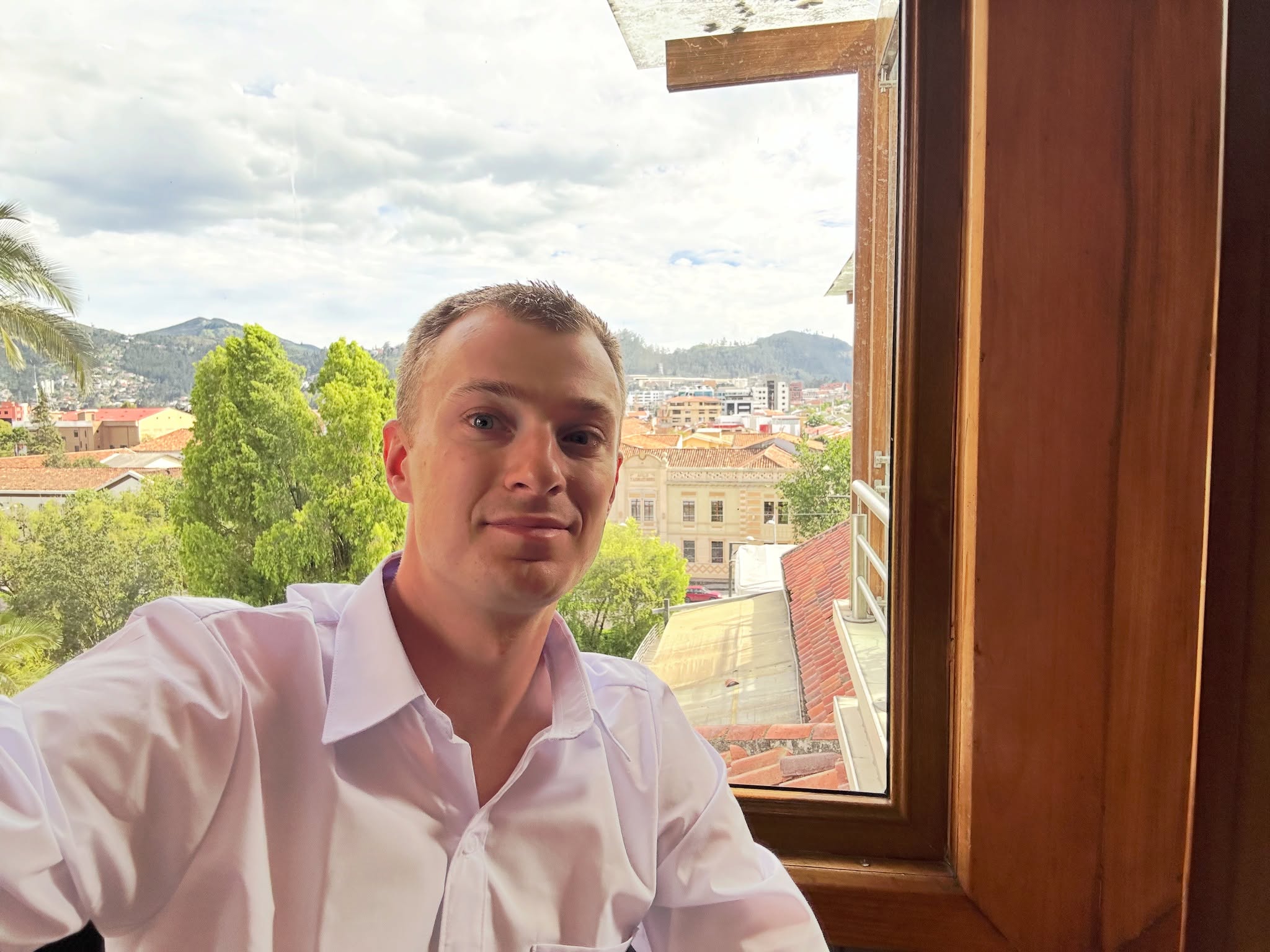
About the Author
Chip Moreno — American Expat in Cuenca, Ecuador
Chip is the founder of EcuaPass (Ecuador visa services), FileAbroad (U.S. taxes for expats), EcuaInsure (health insurance), EcuadorTranslations, and CuencaExpat (daily news). He holds a B.S. in Computer Science from WGU, obtained his Ecuador Professional Visa in 2025, and is pursuing the IRS Enrolled Agent credential and an Ecuadorian insurance broker license.