How to Prove Your Pension for Ecuador's Rentista Visa: A Lawyer's Step-by-Step Guide
Secure your Ecuadorian Rentista visa by mastering pension proof. Our lawyer's guide covers legal requirements, document authentication (Apostille, translation),
Navigating Your Ecuadorian Retirement Visa: A Lawyer's Guide to Proving Pension Income
As an Ecuadorian lawyer based in the heart of the expat community in Cuenca, I've seen firsthand the mix of excitement and procedural anxiety that defines the relocation process. Securing your residency is the final, critical step to truly calling Ecuador home. The most common pathway, the retiree visa, hinges on one core requirement: providing indisputable proof of your stable, lifelong pension income.
While the concept seems simple, the execution is governed by specific articles of law, ministerial agreements, and unwritten rules of bureaucratic procedure. A misstep here can lead to frustrating delays or outright rejection. This guide is designed to provide the clarity and expert detail needed to build a flawless application, reflecting my direct experience assisting clients with the Ministry of Foreign Affairs and Human Mobility (Ministerio de Relaciones Exteriores y Movilidad Humana - MREMH).
The Legal Framework: What Ecuadorian Law Demands
The legal basis for the retiree visa, now officially categorized as the Visa de Residencia Temporal de Rentista, is established in the Ley Orgánica de Movilidad Humana (LOMH). Specifically, Artículo 60, numeral 3 outlines the requirement for a "rentista"—an individual receiving a stable, recurring income from a foreign source.
The core of the requirement is demonstrating sufficient funds to support yourself without employment in Ecuador. The financial threshold is not arbitrary; it is directly tied to Ecuador's Salario Básico Unificado (SBU), or Unified Basic Salary, which is adjusted annually.
- Hyper-Specific Detail 1: Current Financial Threshold. As of 2024, the SBU is $460 per month. The primary applicant for a Rentista visa must prove a minimum monthly income of three times the SBU, which currently calculates to $1,380 USD. For each dependent family member included in the application (e.g., a spouse or child), an additional one SBU ($460) of proven monthly income is required. Relying on outdated blog posts with old SBU figures is a guaranteed way to have your application flagged for insufficiency.
The income must be proven to be permanent and indefinite—essentially, for the rest of your life. This is a critical point that is often missed. A short-term annuity or a time-limited pension payout will not qualify.
Essential Documents: The Anatomy of a Perfect Submission
The Ecuadorian immigration authorities require a precise and verifiable paper trail. Each document serves a specific purpose, and the chain of authentication must be perfect.
1. The Official Pension or Social Security "Award Letter"
This is your foundational document. It cannot be a simple letter from a bank or a financial advisor. It must be an official certificate issued by the governing body of your pension (e.g., the U.S. Social Security Administration, a national pension service, or a private pension fund administrator).
- Content Requirements: The letter must explicitly state:
- Your full legal name as it appears on your passport.
- The monthly pension amount in its original currency.
- Crucially, it must include language confirming the pension is "for life," "indefinite," or "permanent." The absence of this specific language is a common reason for a request for clarification (
petición de subsanación), which delays your application.
2. The Document Authentication Chain: A Common Point of Failure
Foreign documents are not accepted at face value. They must undergo a strict authentication process.
- Hyper-Specific Detail 2: The Correct Order of Operations. The single most costly and time-consuming mistake expats make is translating a document before it is apostilled. The correct, non-negotiable sequence is:
- Obtain the Original Document in your home country.
- Get it Apostilled by the designated authority in your home country (e.g., the Secretary of State in the U.S.). The Apostille authenticates the signature on the document for international use under the Hague Convention.
- Bring the Apostilled Document to Ecuador.
- Have it Translated into Spanish by a translator whose credentials are officially recognized by the Ecuadorian government. A general translation is insufficient. The translator will often attach a sworn declaration to their work.
- In some cases, the final translated document package may require notarization by an Ecuadorian Notary.
3. Bank Statements: The Corroborating Evidence
These statements prove that the income described in your award letter is actually being received.
-
Period: You will need, at minimum, the last six consecutive months of official bank statements. Providing a full year is even better.
-
Content: The statements must clearly show deposits that correspond to your pension income. Online printouts are often rejected. You must submit official statements generated by the bank, either as PDFs downloaded from your online portal (if they look official) or physical copies.
-
Hyper-Specific Detail 3: The "Cleanliness" of Funds. While not an official rule, an experienced reviewer at the MREMH looks for consistency. If your statements show the pension being deposited and then immediately transferred out to another account in its entirety, it could raise questions about the availability of those funds for your living expenses in Ecuador. It is best if the funds are clearly shown residing in the account for a reasonable period.
The Application Process: From Document to Cédula
Applications are now primarily managed through the government's online portal.
- Hyper-Specific Detail 4: Navigating the Online System. The official platform is the
Sistema Virtual de Trámites Consulares GAC. Be aware that this system can be temperamental. It is known to work best with specific browsers (often Mozilla Firefox) and requires patience. File sizes for uploads are strictly limited, so you must scan your documents to be clear but compressed (e.g., under 1 MB per file). Attempting to upload a 10 MB photo of a document will fail.
- Document Compilation: Gather, apostille, and translate all necessary documents as described above.
- Online Application: Create an account on the GAC portal, fill out the application form (
Formulario de Solicitud de Visa), and meticulously upload each required document into the correct category. - Fee Payment: Pay the application fee, which consists of a processing fee (currently around $50) and the visa issuance fee (currently around $400).
- Visa Order Issuance: Once approved, you will receive an electronic visa order (
orden de visa electrónica). - Visa Stamping &
CédulaOrder: You will then schedule an appointment at an MREMH office (e.g., in Cuenca, Quito, or Guayaquil) to have the electronic visa registered and to receive yourorden de cedulación—the mandatory order required to apply for your national ID card. - Registro Civil: With your
orden de cedulaciónand passport in hand, you will go to theRegistro Civilto be fingerprinted, photographed, and issued your Ecuadoriancédula.
- Hyper-Specific Detail 5: The Cuenca
Registro CivilNuance. A common expat frustration at the mainRegistro Civiloffice in Cuenca (on Av. Remigio Crespo Toral) is arriving without a pre-paid payment receipt. You must first go to the attachedBanco del Pacíficoagency inside or next to the building to pay thecédulafee (currently $5 for the first time). You cannot pay at the window where you are processed. Bring the payment receipt with your other documents to the information desk to get your turn number (turno).
⚠️ Legal Alert: When to Stop and Consult an Attorney
Hiring a lawyer is not always necessary, but you should immediately seek professional counsel if:
- Your pension is a complex mix of sources (e.g., part social security, part private annuity, part military pension). Consolidating this into a clear, approvable format requires legal strategy.
- Your monthly income is very close to the $1,380 minimum. Any fluctuation in currency exchange could drop you below the threshold, and a lawyer can help structure the proof to mitigate this risk.
- Your pension award letter does not contain the words "for life" or "indefinite." We often have to work with pension administrators to issue a supplementary letter that satisfies this specific Ecuadorian requirement.
- You have a complex immigration history or a previous visa denial.
Proving your pension income is the most document-intensive part of your residency application. By following this expert guide—paying close attention to the legal articles, financial thresholds, and the precise order of document authentication—you can replace uncertainty with a clear, compliant strategy.
Your new life in Ecuador is waiting. Ensure your journey starts with a successful application.
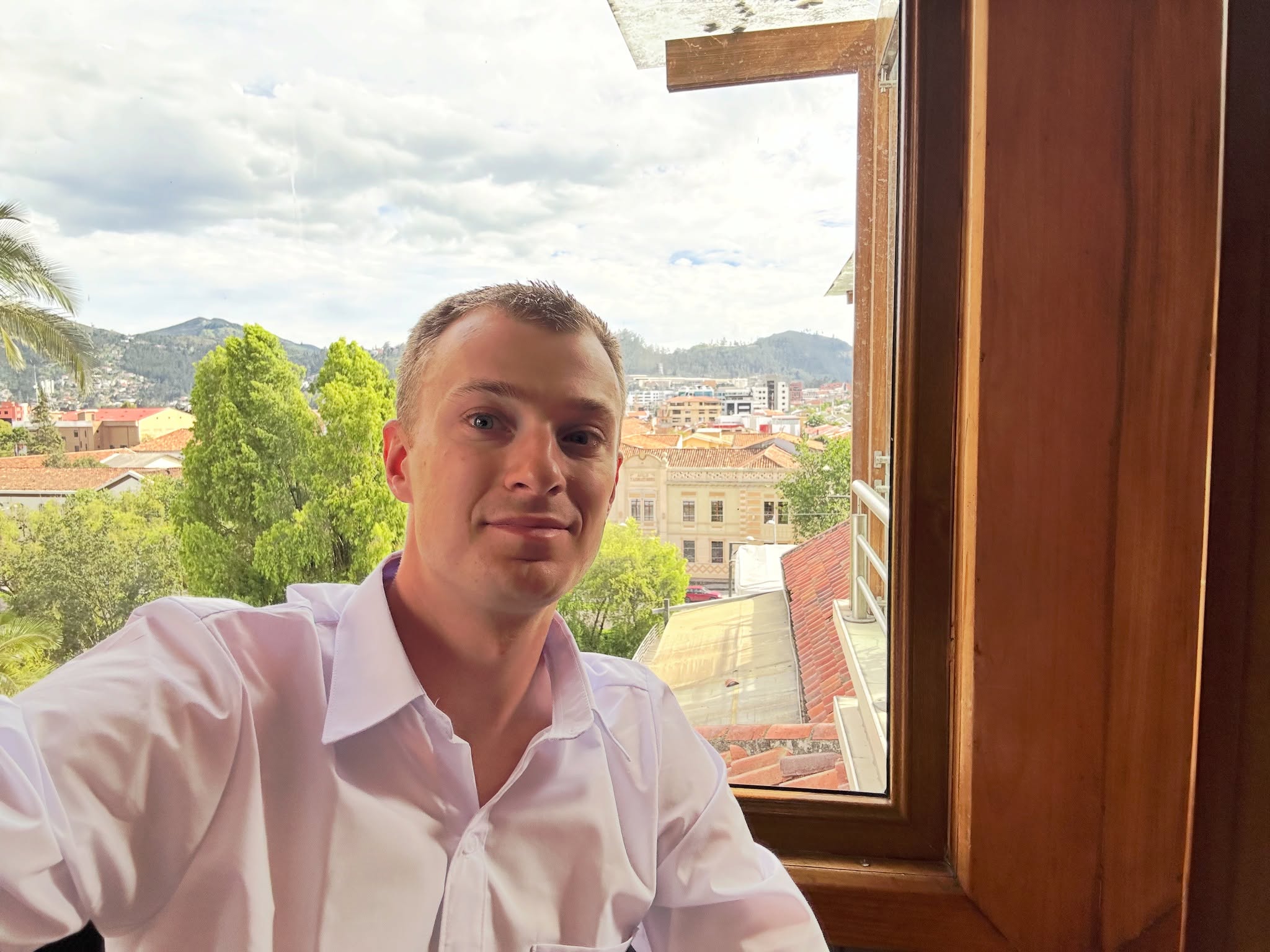
About the Author
Chip Moreno — American Expat in Cuenca, Ecuador
Chip is the founder of EcuaPass (Ecuador visa services), FileAbroad (U.S. taxes for expats), EcuaInsure (health insurance), EcuadorTranslations, and CuencaExpat (daily news). He holds a B.S. in Computer Science from WGU, obtained his Ecuador Professional Visa in 2025, and is pursuing the IRS Enrolled Agent credential and an Ecuadorian insurance broker license.